
Ventilation
The task of ventilation in buildings is the constant replacement of polluted air from the room with fresh air from the free atmosphere to maintain the necessary hygienic conditions necessary for a healthy and comfortable stay for people. The role of ventilation is also to heat the air if necessary, to remove excess moisture and harmful gases from the room, and to cool the air in the summer.
The following recommendations are important for comfortable living and maintaining the health and full working capacity of persons: the air temperature in winter in residential areas should be 21 ± 1 ° C.
In summer temperatures between 24 and 26 ° C are comfortable; deviations of the mean temperature of the peripheral surfaces (walls) from the air temperature must not exceed 2 to 3 ° C; in winter the relative humidity is 40% to 50% and in summer 50 ± 5%. Values below 30% are medically undesirable as they result in airway drainage; the air flow velocity in the occupied area should be from 0.1 to 0.3 m / s.
Ventilation can be divided into: natural ventilation and mechanical ventilation.
Natural ventilation involves the exchange of air in a room without the use of a fan, that is, it takes advantage of natural laws to change the air in an enclosed room. Indoor air changes due to chimney effect (cause of flow). The chimney effect is a phenomenon that causes the warm air to flow through the building upwards due to the difference in temperature, ie the difference in the density of hotter and colder air. It takes place through the infiltration of air through the windows of windows and doors, and walls, by opening windows and doors, and by exchanging air through ventilation ducts. The advantages of this type of ventilation are low investment costs, easy maintenance, low cost energy, low airflow speed, low noise and reduced greenhouse gas emissions. The disadvantages are poor efficiency, poor management capability and dependence on weather conditions.
Gap infiltration involves the penetration of air through gaps in windows and doors, and in a small part through exterior walls. The penetration of fresh air into the room by the infiltration process depends on the size of the gap in the exterior windows and doors. The condition for this change is the difference in pressure between indoor and outdoor air as a consequence of the difference in temperature and energy [wind | wind]]. In winter, the number of air changes in residential areas is 0.3 to 0.8 h-1. Newer windows that have a lower heat transfer coefficient often have an air exchange of only 0.1 h-1, so rooms that have such windows should either open windows or use mechanical ventilation. The minimum number of air changes per hour in a dwelling shall not be less than 0,5 h-1. This type of ventilation is not sufficient and should be used in combination with the opening of windows and doors.
Opening the windows and doors achieves the most intense air change in the room. It depended on wind speed, the difference between indoor and outdoor air temperatures, the type of windows and shutters, and the layout of the windows in the building. The approximate number of air changes that can be achieved when used with closed windows and balcony doors, and at different window sills and window shutters are shown in the table. Most people ventilate their rooms by opening windows, which distinguishes between long and short-term ventilation. It should be borne in mind that short ventilation by fully opening the window and balcony doors, especially from the point of view of protection against colds and saving heat for heating, is better than permanent ventilation through half-open doors or windows. At equal intervals, for example, every hour I open the window for 5 to 10 minutes, thereby changing the total amount of old air.
Natural ventilation through ducts means the exchange of air in a windowless room through vertical masonry ventilation ducts running from the associated room to above the roof of the building. It should be borne in mind that this type of ventilation works only if it is ensured that fresh air is supplied in adequate quantities at all times. The air is introduced through an opening on the wall or bottom of the door leaf and is discharged from the room through an opening below the ceiling with a connection to the ventilation duct. Vertical ducts have adjustable dampers in order to control room air exchange.
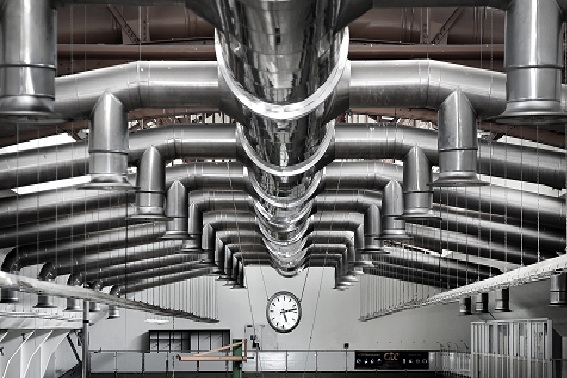
Mechanical ventilation is the forced exchange of air indoors through vertical channels mechanically driven by a fan. Such ventilation is performed in an area with a strong wind swirl or during periods when there is no natural ventilation or when it is not sufficiently effective. The advantages of such ventilation are: it does not depend on the weather conditions, a large selection of equipment, the possibility of regulation and a simplified system design process. The disadvantages are high investment costs, high energy consumption, air recirculation and noise.
Mechanical ventilation is divided into: suction, pressure, suction-pressure.
With non-exhaust ventilation, the room is under pressure (less than ambient pressure), which prevents the spread of bad air. The fan sucks the air in and out. It is used in kitchens (hoods), bathrooms, etc.
Pressure ventilation works in such a way that pressure ventilation devices inject outside air into the ventilated area. The room is kept pressurized in relation to the adjacent rooms and the environment, thus preventing the flow of contaminated air into the ventilated area, that is, excess air flows into the adjacent rooms or towards the environment through windows and doors. In winter, the air being injected into the room needs to be warmed up to room temperature using an air heater. The basic parts of the ventilation chamber are the fan, the heater and the air filter, and the air supply duct. The disadvantage of pressure ventilation is the inability to return heat from room air. This type of ventilation is applicable in rooms, classrooms, etc.
Pressure and suction ventilation is suitable for large rooms. Fresh air is introduced into the room, while used air is expelled. It is used for comfort and industrial ventilation.
The filter is a piece of ventilation system equipment that removes pollutant particles from the ventilation air. Using a filter increases the level of comfort, but also increases the cost of operating and maintaining the system. Placing the filter in a ventilation or air-conditioning unit not only purifies the air, but also protects the other devices installed in the system from the accumulation and deposition of impurities. This indirectly protects the building elements from contamination and damage. The basic factors in air filtration are filter materials, ie filter cartridges, or shorter, filters. The filter as a final product consists of one, two or three filter cartridges, the last one installed in the series is called a filter and the previous pre-filters. Modern filters today allow particle retention in a wide range of 0.1-500 μm.