The most favorable heating
The best heating depends on a lot of factors. The most important factor influencing the choice of heating type and system still unfortunately depends on the global energy policy, behind which there is essentially a big profit and higher profits on the energy of those who exploit and distribute them, and “spend” as earnings from state structures. , who take their big share of the cake in the whole energy-related story.
From the time after the original communion, through the period of slaves in the era of Pharaohs and serfs in the feudal period, and the cotton pickers on American plantations, the so-called philosophy of the so-called human development and progress have changed little. On the contrary, today human civilization is based on the search for the most perfidious ways to reduce the so-called. the “cream” of the human race like parasites lives on the hump of the vast majority of human civilization.
In all of the above, energy has played a role in this. So are the energy-efficient ones, which take up a significant amount of the home and industrial-business budget.
Over the past few decades, energy has been constantly exchanged for the advantage of being used for the most favorable heating. Wood as a fuel for heating has always been among the most favorable, if not the most favorable. However, there were stages in some past time when energy such as the hit music came along, which for some reason was even more favorable than wood. Thus, at one point, even electricity was more favorable in combination with thermal storage furnaces, which were recharged at night during cheaper tariffs. Then there was the sweep of oilseeds that used fuel oil, which at that point was really advantageous.
The era of gasification brought natural gas as a heating energy, which was initially at a bargain price for the small consumer, or below 2 euro cents per kWh of heat. However, after the entrenched gas infrastructure and its consumption, by the method of bait for fish and lion traps, the price of natural gas went up several tens of times higher than it was at the time of mass gasification, so today natural gas has become strong a means of blackmailing both towards the little man and in interstate relations and policies.
However, the development of heating technology has never failed to seek new solutions for the most favorable heating, which so far have always been based on finding ways to heat cheaply.
Environmental pollution, both air and water and soil, forces the future development of heating technology in demand, in addition to the most economically advantageous and also the most energy efficient in terms of environmental protection. To say “the devil made a joke”, but the expansion of industry and transport has to a great extent contributed to endangering the entire eco-system of the planet, so that in the coming period energy efficiency with the aim of protecting nature will represent “be or not” in the literal sense, so so is energy technology.
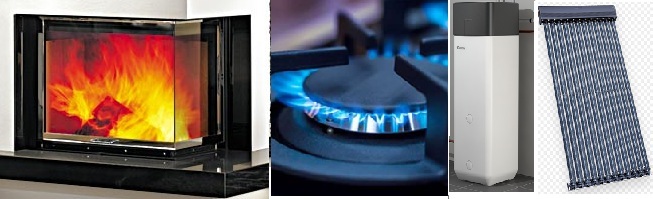
In this regard, some new systems have evolved in the past ten years in connection with the above. Wood as an energy source is still present, but with far more efficient technologies such as so-called timber pyrolysis boilers (in burning wood, visible flames are not only due to the combustion of wood, but also due to the gases released by its pyrolysis). Electricity as energy has returned to the big door but also with new technology of using the same as so called. heat pumps, which, in combination with electricity and the working substance of compression systems, utilize heat from air, land and groundwater.
Solar systems, whether water or photovoltaic, which can significantly participate in large scale as an operationally free source of heat in combination with wood, electricity or gas, as a base energy are also increasingly popular. Fuel oil and LPG gas are less and less used in environments where we have an electrified and gasified environment, so that these energy products can be very rarely encountered in the construction of new thermal energy systems.
So-called industrial systems have been popular for industrial systems lately. cogeneration and trigeneration systems where two energy sources (heat and electricity) or even a third energy source (cooling energy) are produced by a single energy source (waste wood chips, natural gas, bio-gas in combination with corn silage, less frequently diesel fuel). These systems are often linked to other economic systems such as pig and cattle farms in front of cogeneration systems and greenhouses and cooling warehouses and the like after cogeneration systems.
In addition to the system in the consumption of thermal energy, the construction aspect of the consumer or the facility in terms of thermal insulation is also important. Better insulation of the building will have an effect and less need for thermal energy. This is how the so-called construction technologies have been developed today. low energy and passive facilities that require very small amounts of heat and can be heated at low temperatures, whose systems are extremely economical and efficient.
So today, the technologies of construction of so-called low-energy and passive objects have been developed, which require very small amounts of thermal energy and can be heated at low temperatures, whose systems are extremely economical and efficient.
Unfortunately, systems that are energy efficient and thus have low operating costs are relatively expensive. The amounts that need to be invested in such systems are often ultimately unprofitable and available to practically only a small number of wealthy people who are not as financially relevant as heating spending. For example, it is the cheapest investment in heating system equipment with classic electric heaters, which are extremely cheap. Equipment for heating a single-family home or apartment would cost 100 … 200 euros, but therefore the operating overheads of the electricity consumed would be extremely high. In contrast, heating systems with heat pumps combined with photovoltaic solar systems in a house built as a low-energy or passive facility would be virtually free of cost of heating (and cooling), but the cost of such a system of heating and construction is still so high that it is still financially it pays more classic construction with a classic heating system.
Some countries, however, are aware that saving and reducing energy consumption generally conserves energy resources, protects the environment, reduces investment costs in maintaining existing and building new large energy systems, and encourages and subsidizes the construction of energy efficient systems for residential and commercial buildings and technologies.
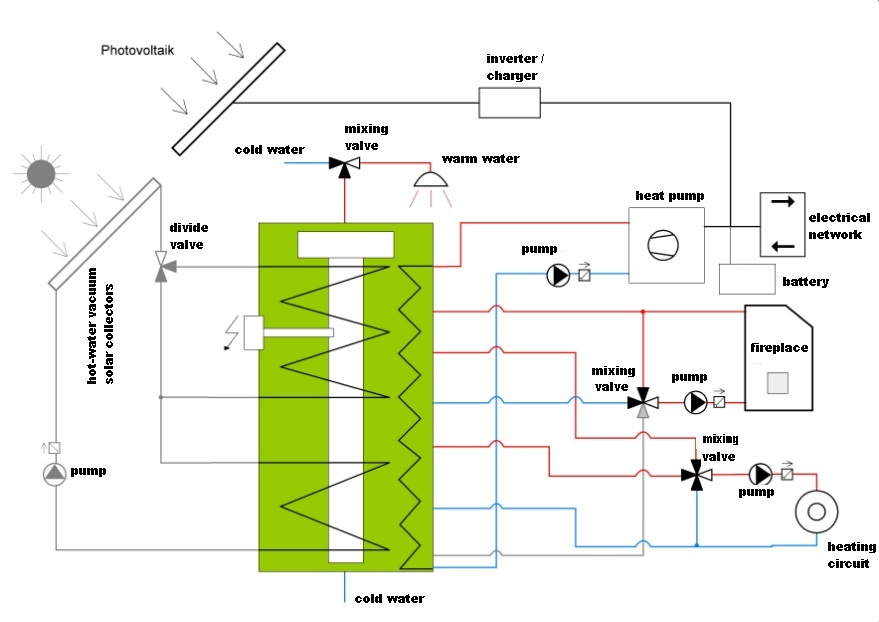
Considering the generous financial incentives and subsidies given in some countries for renewable energy sources, which are extremely energy efficient, one could say that the current trend in these countries is the most profitable investment in the construction of so-called renewable energy sources. low energy and passive facilities, which are equipped with heating systems based on the principle of heat pumps, which would be supported by solar thermal and photovoltaic technologies. The professional term for such buildings is the so-called “Almost zero energy buildings”, whose CO2 emissions are negligible and fit into the latest environmental policy concepts.
It is difficult to bring the buildings of the older construction year to the level of the so-called. “Almost zero energy buildings”. Today, energy renovation uses the principles of replacement of windows and doors with higher thermal resistance (with triple glazing and double insulating glass chamber) thermal insulation of exterior walls, ceilings and roofs (with styrofoam or wool). In addition to the structural reconstruction of the building, condensation systems for gas generators with the support of solar collectors can be installed in such buildings. This can reduce the cost of heat consumption by over fifty percent.
It should be noted that in many countries, despite some contradictory lobbying theses, wood is still the most favorable energy source, at least when it comes to heating older buildings. It is present as an energy source in new and renovated buildings as an additional energy source in the form of a central heating fireplace, among other things as aesthetic atmosphere in the living room, which is integrated into the hybrid heating system with gas condensing appliances or with heat pumps.